The Complete Guide to Brooks' Current Range: Which Shoe Fits Your Running?
Author: Running Style | Published: 18 August 2026 | Updated: 18 August 2026
Brooks currently sells more than a dozen distinct running shoe lines, several with two or three live versions on shelves at once. That is a lot of choice, and most of it is not really about which shoe is “best”. It is about which shoe matches what you are trying to do. This guide works through the current range by use case, using the weights, drops, stack heights and prices we have verified for our own shoe database.
Start with three questions
Before looking at individual shoes, it is worth answering three things directly.
How much cushioning do you want? More foam underfoot is not automatically better. A thickly cushioned shoe can feel plush and forgiving on long runs, but it also feels less precise and, in some runners’ experience, less stable at faster paces.
Do you pronate enough to need extra support? A stability shoe is only useful if you overpronate significantly. If a podiatrist, physio, or gait analysis session hasn’t told you that, a neutral shoe is the default starting point.
What are you training for? Long, steady mileage calls for a different shoe to interval sessions or race day. Trying to make one shoe do everything usually means it does nothing especially well.
Neutral daily trainers: the Ghost family
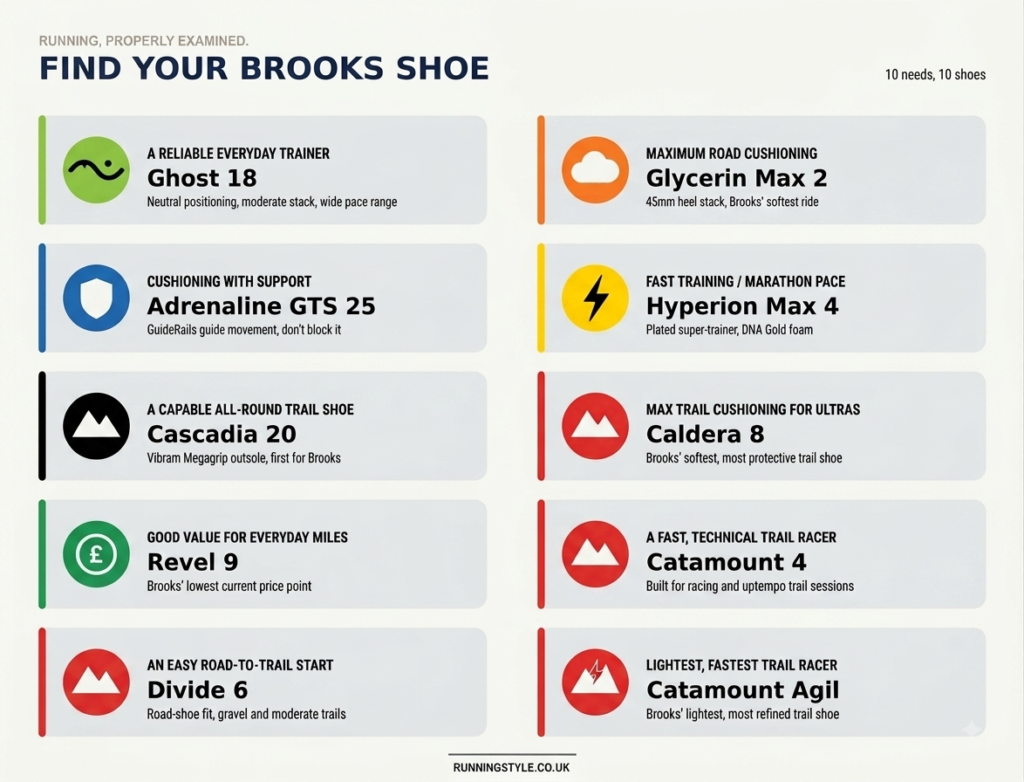
The Ghost line is Brooks’ mainstream neutral trainer, and the Ghost 18 is its default option. It uses Brooks’ DNA Loft v3 midsole and sits at a moderate stack height suited to a wide range of training paces, without feeling either harsh or overly soft.
For runners who want noticeably more cushion without moving to a specialist max-cushion shoe, the Ghost Max 4 takes the same neutral positioning and adds significant stack height. It launched in August 2026, so UK pricing was still settling in at the time of writing.
The Ghost Amp sits alongside the Ghost line as a slightly different proposition: broadly similar positioning, but with its own cushioning tune. It has no numbered predecessor, so treat it as a distinct option rather than an “upgrade” to the standard Ghost.
Maximum cushioning: the Glycerin family
If Ghost is Brooks’ default trainer, Glycerin is the plush option. The current Glycerin 23 weighs in with a taller stack height than the Ghost and a noticeably softer ride, aimed squarely at runners who want maximum comfort on longer, easier efforts rather than outright responsiveness.
The Glycerin Max 2 goes further still: it has one of the tallest stack heights in Brooks’ entire lineup, at roughly 45mm heel and 39mm forefoot by our verification, with a correspondingly low 6mm drop. This is a shoe built for runners who have decided that more cushioning is simply better and want Brooks’ softest possible ride.
For something between the two, the Glycerin Flex takes a different approach: a segmented midsole designed to flex more naturally with the foot rather than presenting a single rigid slab of foam underfoot, while retaining Glycerin-level cushioning.
Stability and support
Brooks’ stability options address overpronation without abandoning a cushioned ride. The Adrenaline GTS 25 is the long-running standard-bearer here, now in its 25th version, and remains one of the best-selling stability shoes on the market. It pairs GuideRails support technology, which guides excess movement at the ankle and knee rather than physically blocking pronation with a hard wedge, with cushioning that is closer to the Ghost than the Glycerin.
The Glycerin GTS 23 applies the same GuideRails approach to Glycerin’s plusher, higher-stack platform, for runners who want both stability and maximum cushioning rather than choosing between them.
Speed and racing: the Hyperion family
Brooks’ fastest shoes have gone through real repositioning recently, and it is worth understanding where each one now sits rather than assuming continuity from older reviews.
The Hyperion 3 was, for two generations, Brooks’ lightweight low-stack racer. That changed with this version: it gained meaningful weight and roughly 3mm of extra stack height over the Hyperion 2, and several longtime reviewers have been vocal that it now feels closer to a general daily trainer than the racing flat the Hyperion name used to signify. Worth knowing if you are buying it expecting the older shoe’s character.
The Hyperion Max 4 is Brooks’ plated super-trainer: a nylon SpeedVault plate, a tall stack of DNA Gold and DNA Flash v2 foam, and a propulsive ride, aimed at fast training runs and marathon-pace long runs rather than short, sharp reps.
At the top of the range sits the Hyperion Elite 6, Brooks’ full carbon-plated racing shoe, now in its lightest and most refined form to date at under 200g. Worth noting: it is sold as a unisex shoe rather than separate men’s and women’s versions, which is also true of the Cascadia Elite trail racer and the Catamount Agil.
Under 200g: the weight of Brooks’ lightest, most refined racing shoe yet, the Hyperion Elite 6.
Budget and entry-level
Not every runner needs, or wants, premium foam and a plated midsole. The Launch 12 is Brooks’ entry-level speed-oriented trainer, light and inexpensive relative to the rest of the range, though it runs narrow through the toe box according to independent lab measurement, worth knowing if you have wider feet. The Revel 9 is pitched even more squarely at value and everyday versatility: running, gym sessions, and daily wear rather than performance training specifically, at Brooks’ lowest current price point.
Trail: matching the shoe to the terrain
Brooks’ trail range has seen the most change of any part of the lineup recently, and different shoes now serve distinctly different terrain.
The Cascadia 20 is the long-running flagship, and this version marks a real shift: it switches from the plush DNA Loft v3 foam used for years to the firmer, faster DNA Flash v2, alongside a first-time switch to a Vibram Megagrip outsole for grip. The result trades some of the previous generation’s comfort for a firmer, more energetic ride, better suited to technical terrain that demands traction over plushness.
For maximum cushioning on long trail days, the Caldera 8remains Brooks’ softest, most protective trail shoe, aimed at ultra-distance running rather than technical or fast terrain.
The Catamount 4 sits at the fast, low-to-the-ground end of the trail range: a lighter, firmer shoe with a SkyVault plate, intended for racing and uptempo trail sessions rather than long, easy miles. Alongside it, the Catamount Agil goes further still, Brooks’ lightest and fastest trail shoe, built for short, technical racing under 50k, and, like the Hyperion Elite and Cascadia Elite, sold as a unisex shoe.
For runners easing into trail running from the road, the Divide 6is Brooks’ hybrid option: a road-shoe-inspired fit and ride with just enough trail-specific traction and protection for gravel paths and moderate, non-technical trails. It is not built for properly rugged terrain, and the Cascadia is the better choice once trails get technical.
Find your shoe at a glance