From Ballet Slippers to the Boston Marathon: The Brooks Running Story
Author: Running Style | Published: 18 August 2026 | Updated: 18 August 2026
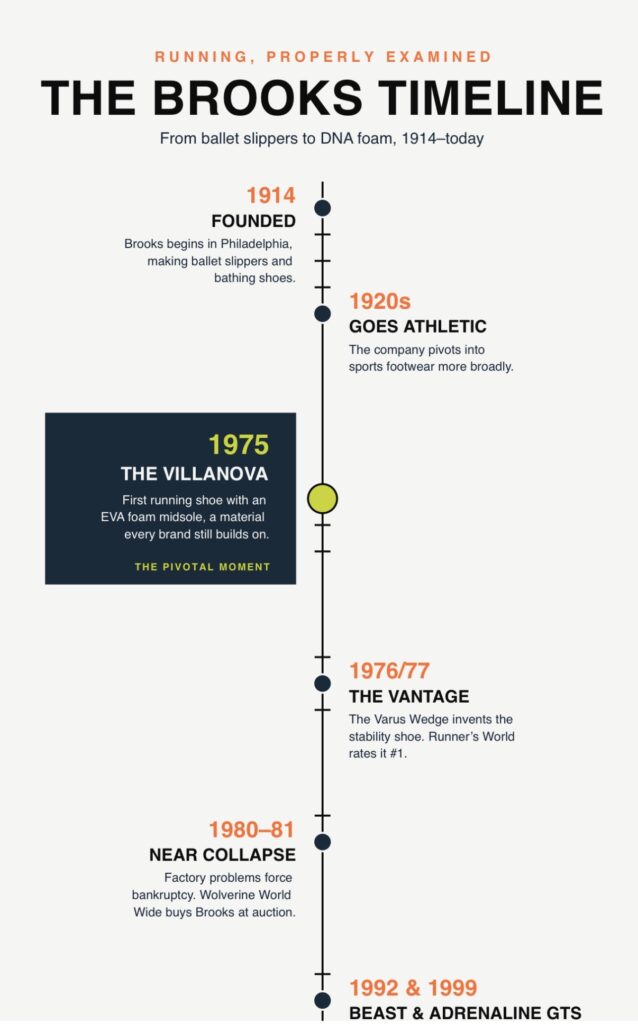
Brooks Running did not start out making running shoes at all. The company was founded in 1914 in Philadelphia, producing ballet slippers and bathing shoes, according to Brooks’ own company history page. It would take more than half a century, several changes of ownership, and one industry-changing midsole material before Brooks became the running-focused brand it is today.
A slow pivot to sport
Brooks moved into athletic footwear from the 1920s onward, adding baseball, football, and other sports cleats to its range well before running became the focus. One often-repeated piece of company lore, dated by Brooks’ own history page to 1962, has then-CEO Jerry Turner walking into the New York Yankees’ locker room with a box of cleats under each arm. Roger Maris turned him down; Mickey Mantle tried a pair, liked them, and bought both. It was not until the early 2000s that Brooks narrowed its focus to running exclusively.
The shoe that changed the industry
The single most consequential moment in Brooks’ history arrived in 1975, with a shoe called the Villanova. Working with chemical engineer David Schwaber at the Monarch Rubber Company, Brooks became the first running shoe brand to use ethylene vinyl acetate, or EVA, in a midsole, according to podiatrist Kevin Kirby’s account of the shoe’s development. EVA foam was lighter and offered more rebound than the harder rubber compounds used in midsoles up to that point, and it has been standard in running shoe construction ever since.
1975: the year Brooks put the first EVA foam midsole in a running shoe, a material still standard in the industry today.
The Villanova took its name from Olympic middle-distance runner Marty Liquori, a Villanova University alumnus who helped guide the shoe’s design, according to Villanova’s own Falvey Library blog. Liquori was the youngest athlete to reach the 1,500m Olympic final, at the 1968 Mexico City Games. One runner who wore the Villanova during its first cross-country season recalled the difference the new foam made underfoot, describing it as noticeably more cushioned and “bouncier” than anything the team had trained in before, in an account published on the podiatry site Podiatry Today.
The Vantage and the birth of the stability shoe
Brooks followed the Villanova with the Vantage, a shoe built around a wedge-shaped piece of harder foam under the arch, designed to reduce overpronation, where the foot rolls inward more than is efficient after landing. The Vantage’s exact release date is contested: sneaker-history site Runblogger dates the launch to 1976, while a vintage print advertisement archived by vintage-sneaker blog The Deffest places the shoe’s Runner’s World number-one ranking in the 1977 training-shoe survey. What is not in dispute is the shoe’s significance: the Vantage’s Varus Wedge is widely credited as the shoe that established what the industry now calls a stability shoe, addressing a problem that had no dedicated running-shoe solution before it.
The Vantage also became something of a status symbol. According to Brooks’ company history, then-US President Jimmy Carter, a keen runner, ordered a pair.
Innovation, bankruptcy, and a new owner
Brooks kept experimenting through the late 1970s and into the 1980s. The Hugger GT introduced a breathable Gore-Tex upper, among the first running shoes to do so; the Nighthawk carried the Varus Wedge forward and was rated the best running shoe in the world by Running Times; and the Chariot, a precursor to the modern Beast, used two different densities of EVA foam rather than a solid wedge to manage pronation. All three claims come from Brooks’ own history page.
The company’s fortunes then turned sharply. Production problems at a Brooks factory in Puerto Rico led to the loss of 50,000 pairs of shoes and the company filed for bankruptcy in 1980, according to the Italian-language running retailer MioMioRun’s account of Brooks’ history. Brooks was bought at auction the following year by Wolverine World Wide, the footwear conglomerate that still owns the brand today.
Building the modern lineup
Recovery came through the 1990s. Brooks launched the Beast, a motion-control shoe built around what the brand called diagonal roll bar technology, in 1992. The Adrenaline GTS, an abbreviation of “go-to-shoe” built for runners with a higher arch and a wider forefoot, followed in 1999, according to Brooks’ own history page and multiple independent retailer histories, though some brand retrospectives, including MioMioRun’s, place the launch five years earlier, in 1994. Both shoes became long-running bestsellers; the Adrenaline GTS in particular remains one of Brooks’ flagship models nearly three decades on, now in its 25th version.
In 2001, Brooks made the decision that arguably defines the brand today: it narrowed its focus to running exclusively, discontinuing its wider sports-shoe range to concentrate research and development on one category, according to Brooks’ own history page. The cushioning innovations that followed became signatures of the brand. MoGo, a new cushioning polymer, arrived in 2006; BioMoGo, a biodegradable version of it, followed in 2008; and DNA Cushioning, an adaptive midsole technology built around a non-Newtonian fluid, arrived in 2009, according to Brooks’ own history page and a Complex.comretrospective on sneaker cushioning technology.
From Villanova to now
The line runs fairly directly from that 1975 EVA midsole to the DNA Loft, DNA Flash, and DNA Gold foams found in Brooks’ current lineup, and from the Vantage’s Varus Wedge to the GuideRails support system used in today’s Adrenaline GTS. Brooks has occasionally looked back deliberately: a modern reissue of the Vantage, produced years after the original, retained the Varus Wedge and reproduced the original’s sheet-EVA midsole construction, according to a Runblogger feature on the reissue.
Fifty years on from the Villanova, EVA foam, in one supercritical, nitrogen-infused, or otherwise upgraded form or another, remains the material nearly every running shoe on the market is still built around, Brooks’ own or otherwise.