
Can’t Touch Your Toes? Here’s What to Work On Instead
Author: Running Style | Published: 25 August 2026 | Updated: 25 August 2026
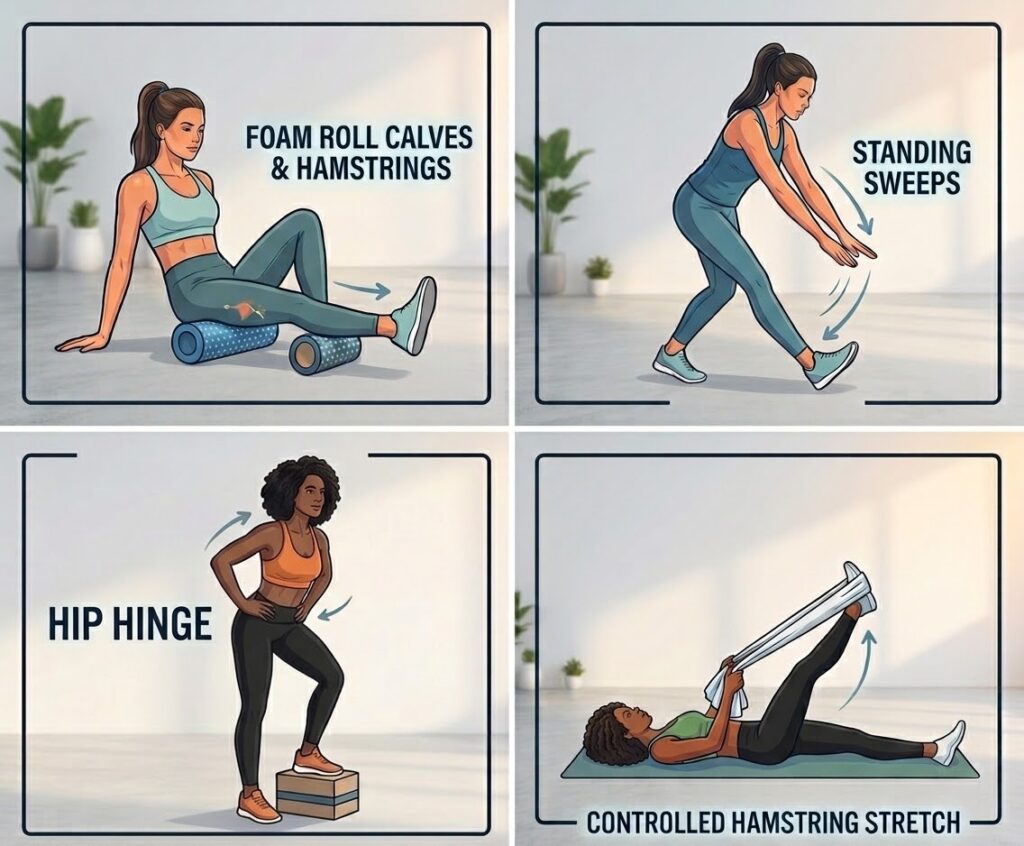
Touching your toes looks like a simple test: bend forwards, reach down and see what happens.
But the distance between your hands and the floor isn’t a single measure of flexibility. It depends on how your hips, hamstrings, calves, spine and nervous system contribute to the movement, as well as your individual anatomy.
If you want to improve your toe touch, the answer isn’t to force yourself further into the stretch. A better approach is to work gradually on the range of motion you have and build tolerance for a little more over time.
Start with the movement, not the end point
A standing toe touch combines movement at several joints.
Your hips need to bend, your hamstrings need to allow the thigh to move relative to the pelvis, your ankles contribute through their position, and your spine can move too.
That means two runners can have similar hamstring flexibility and still have different toe-touch ranges.
It also means that touching your toes isn’t a particularly useful pass-or-fail test. If your aim is to improve the movement, concentrate on making the available range more comfortable and controlled.
Whatever’s behind a tight toe touch, most runners don’t need to work out exactly which part is responsible before starting. Gentle movement and steady stretching are a sensible place to begin regardless.
Don’t force the stretch
A strong stretch sensation isn’t automatically a sign that you’re making better progress.
Pushing aggressively towards the floor can make the movement uncomfortable and may simply encourage you to compensate elsewhere. There is little reason to turn a flexibility exercise into a competition with the floor.
Instead, move slowly into a comfortable range. You can use a slight bend in the knees if that makes the movement more comfortable, then gradually work towards a straighter-legged position if that is your goal.
The aim is controlled exposure to the movement, not forcing your body into a position it doesn’t currently tolerate.
1. Warm up with some gentle movement
You don’t need a complicated warm-up.
- Try 10–12 controlled standing sweeps on each side:
- Step one foot forwards with the heel on the floor.
- Keep a slight bend in the knee.
- Bend forwards from the hips.
- Sweep your hands towards the floor.
- Return to the starting position and repeat.
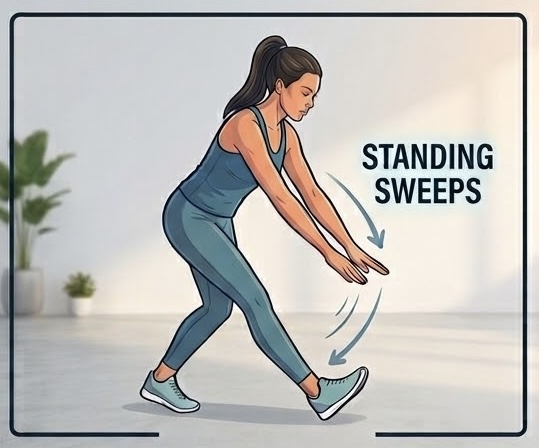
Keep the movement smooth rather than trying to reach a particular point.
This gives you a chance to practise the movement you are trying to improve without immediately holding the deepest position.
2. Practise the hip hinge
Next, work on sending your hips backwards while keeping your back long and steady – like a drawbridge lowering from the hips rather than the spine folding. This movement is called a hip hinge, and practising it helps you find the stretch without turning your lower back into the only part that moves.
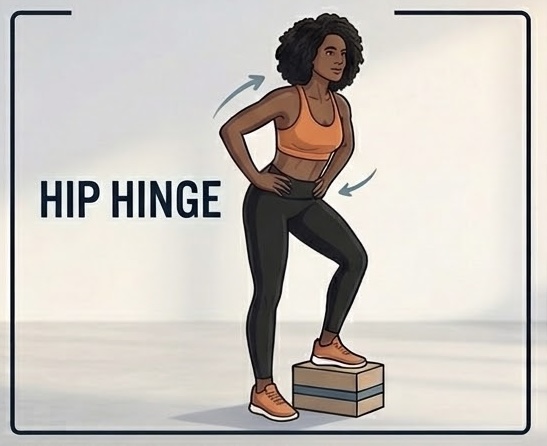
Try a supported single-leg version:
- Place one heel on a low step.
- Keep a soft bend in the knee.
- Place your hands on your hips.
- Push your hips backwards while keeping your back comfortable.
- Stop when you feel a gentle stretch through the back of the thigh.
- Hold briefly, then return to the starting position.
This works the hamstring as part of the whole hip movement, rather than isolating it the way a machine curl would.
3. Use a controlled hamstring stretch
Regular static stretching can increase range of motion over time.
One simple option is a lying hamstring stretch with a towel or strap:
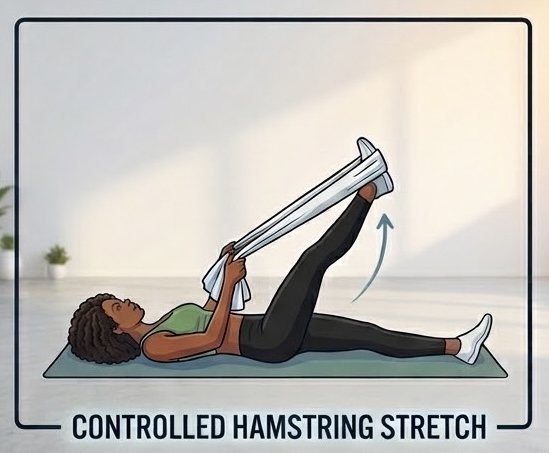
- Lie on your back.
- Loop the towel or strap around one foot.
- Slowly raise that leg.
- Keep the other leg in a comfortable position.
- Stop when you feel a gentle stretch rather than pain.
- Hold the position while breathing normally.
- Repeat on the other side.
There is no need to pull the leg towards you as far as possible.
4. Foam rolling is optional
A 2024 systematic review and meta-analysis by Konrad and colleagues, published in Sports Medicine, found that both static stretching and foam-rolling programmes increased joint range of motion over time, with no meaningful overall difference between the two methods (Konrad et al., 2024).
Foam rolling can be useful if you like it, but it isn’t a requirement for becoming more flexible.
A 2020 systematic review and meta-analysis by Wilke and colleagues found that a single session of foam rolling increased range of motion in healthy adults, though it wasn’t more effective than stretching (Wilke et al., 2020).
A later review by the same research group, looking at longer foam-rolling programmes, also found improvements in range of motion, though the effect varied between muscles and joints (Konrad et al., 2022).
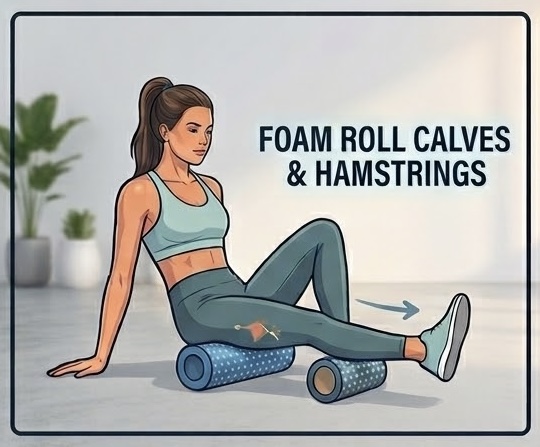
So if you have a foam roller, a short session on the calves or hamstrings is a reasonable addition. If you don’t, you aren’t missing the essential part of the routine.
A simple routine
If touching your toes is your goal, you could combine the exercises above into a short routine:
- Standing sweeps
10–12 repetitions per side.
- Hip hinge
30 seconds per side.
- Lying hamstring stretch
30–60 seconds per side.
- Optional foam rolling
A short, comfortable session on the calves or hamstrings.
- Repeat the toe-touch movement
Try it again and see whether the range feels different.
You don’t need to force the final movement. The useful information is whether your range feels more comfortable or controlled after the preparation.
How often should you stretch?
The American College of Sports Medicine recommends stretching major muscle groups at least two to three days a week to maintain flexibility, and notes that daily stretching produces the biggest gains in range of motion (ACSM).
If you’re working specifically on your toe touch rather than just maintaining what you’ve got, aiming for around four sessions a week is a reasonable middle ground between those two figures. There’s nothing special about that number beyond it being achievable for most runners without turning stretching into a daily chore — more frequent sessions should help further, and less frequent ones will still make a difference, just more slowly.
The important point is consistency rather than turning every session into an aggressive stretching workout.
When stretching isn’t the answer
Not every restriction is a flexibility problem.
If you have pain rather than a simple stretching sensation – particularly if it is persistent, worsening or comes with numbness or tingling – don’t try to stretch through it.
Likewise, if an existing injury or medical condition affects your movement, individual advice from an appropriate healthcare professional is more useful than following a generic flexibility routine.
The takeaway
Touching your toes isn’t a test of one muscle.
The movement involves the hips, hamstrings, calves, spine and nervous system, and the amount of movement available varies between individuals. If you want to improve it, work gradually on the range you have rather than forcing your way towards the floor.
Stretching and foam rolling can both improve range of motion. Neither needs to be treated as a magic fix.
The floor isn’t going anywhere. There’s no need to chase it.
Information only: This article is intended as general information about flexibility and exercise. It isn’t a diagnosis or a substitute for individual assessment or treatment from a qualified healthcare professional. Stop an exercise if it causes pain, and seek professional advice if you have an injury, persistent symptoms or a medical condition that affects movement.