
Do Runners Need to Eat More Protein?
Author: Running Style | Published: 19 August 2026 | Updated: 19 August 2026
Protein has a reputation as the bodybuilder’s macronutrient: the one for people breaking muscle down under a barbell so it can rebuild stronger. Running is aerobic rather than muscular, so it would seem to sit outside that logic entirely. It doesn’t, quite. Endurance exercise burns some protein directly as fuel and increases the rate at which muscle tissue is broken down and rebuilt afterwards, which is why sports nutrition bodies set a higher target for runners than for the general population. The number is real, but it’s also smaller than you might think. For most runners eating a reasonably varied diet, closing it takes very little.
What Endurance Training Does to Protein Needs
During prolonged running, particularly in the later stages of a long session when glycogen stores are running low, amino acids are oxidised for energy alongside fat and carbohydrate. Running also increases muscle protein breakdown and synthesis in the hours after a session, as the body repairs the fibres used during the effort. Neither process is unique to lifting weights, which is the physiological basis for a runner’s protein target sitting above the general population’s.
The UK’s general reference nutrient intake (RNI) for protein is 0.75g per kilogram of body weight per day, a figure set to prevent deficiency across the population rather than to optimise athletic performance. For a 70kg adult that works out at roughly 52.5g a day. Average UK intake already clears that comfortably: adults aged 19 to 64 consume around 76g a day on average, well above the RNI, according to the British Nutrition Foundation’s analysis of National Diet and Nutrition Survey data. The Foundation’s own assessment of that figure is blunt: for anyone doing a moderate amount of physical activity, including running, the average UK diet is unlikely to be short on protein at all.
The Numbers, Set Side by Side
The International Society of Sports Nutrition (ISSN) has twice reviewed the research on protein and exercise, in 2007 and again in 2017. The 2007 paper’s discussion of sport-specific research put the figure for endurance athletes at 1.2 to 1.4g per kilogram of body weight per day, roughly 84 to 98g for our 70kg runner, narrower than the ISSN’s own formal position at the time, a broader 1.4 to 2.0g per kilogram for exercising individuals generally. The 2017 update kept to that broader range.
Set against average UK intake, the gap at the lower end of that range is modest. For a 70kg runner, 1.2g/kg means 84g a day against an already-typical intake in the high 70s to mid-80s. That’s the difference of one extra egg, a small tub of yoghurt, or swapping a modest chicken portion for a slightly larger one. It isn’t the difference between an ordinary diet and a specialist one.
8g: roughly the daily protein gap between average UK intake and a runner’s lower-end sports nutrition target, about one extra egg.
The gap only becomes meaningful at the volumes covered by heavier training. A 2016 study using the indicator amino acid oxidation method, a more direct technique than the nitrogen balance studies behind the earlier figures, found requirements in trained endurance athletes were elevated further in the days following a hard training bout (Kato et al., PLOS ONE, 2016), pushing toward the upper end of the ISSN’s 2017 range and, in some of the more recent metabolic research, above it. That’s a genuinely higher demand, but it applies to runners training at high weekly mileage, not to someone doing three or four moderate sessions a week.
Variety Matters More Than Volume
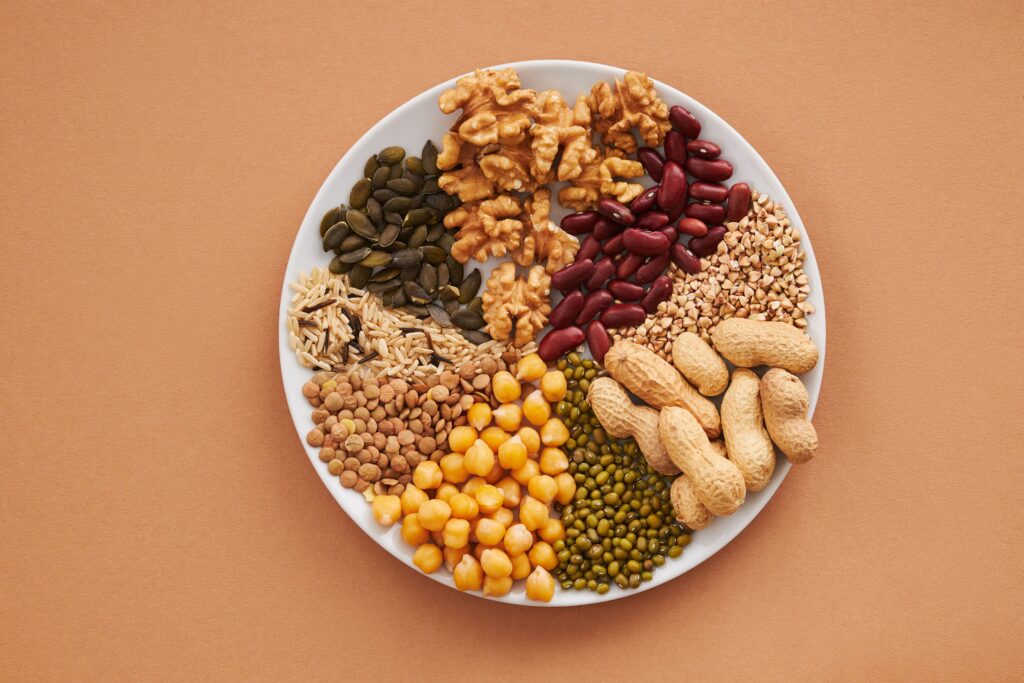
If the quantity of protein in the average UK diet isn’t the issue, where the protein comes from is a more useful question to ask. Meat and dairy still supply the bulk of it for most people, and the wider nutrition consensus, including the British Nutrition Foundation’s own guidance, is that shifting some of that toward plant-derived sources, such as pulses, beans, tofu, and grains, benefits both long-term health and environmental sustainability, without requiring intake to increase. For a runner, that translates into a genuinely more useful question than “am I eating enough protein”: whether the protein on the plate is coming from more than two or three sources on rotation.
Why a Special Diet Is Rarely Needed
None of this means protein prevents injury or guarantees faster recovery outright; the research linking protein intake to those downstream outcomes is associative rather than strictly causal in many cases. What it does mean is that most recreational runners are already close to, or inside, the sports nutrition range without changing anything, simply because a normal diet built around meat, fish, eggs, dairy, or their plant-based equivalents, alongside pulses and grains, tends to supply more protein than the population minimum implies.
The practical takeaway isn’t a protein-focused meal plan. It’s making sure each meal includes a protein source rather than clustering it all into one, which the ISSN’s 2017 position stand also recommends, spacing roughly 20 to 40g doses across the day at three to four hour intervals. A porridge with milk and nuts at breakfast, a chicken or lentil-based lunch, and a dairy or soya-containing evening meal will comfortably clear even the higher end of the range for most training loads. Supplements are a convenience for hitting a distributed target on a busy day, not a requirement in themselves, and runners doing moderate mileage on an already varied diet are unlikely to need to think about protein at all.